
Reviewed · BAKU OLD CITY TOURS
Guided Old City Tour on Baku’s Timeless Charm
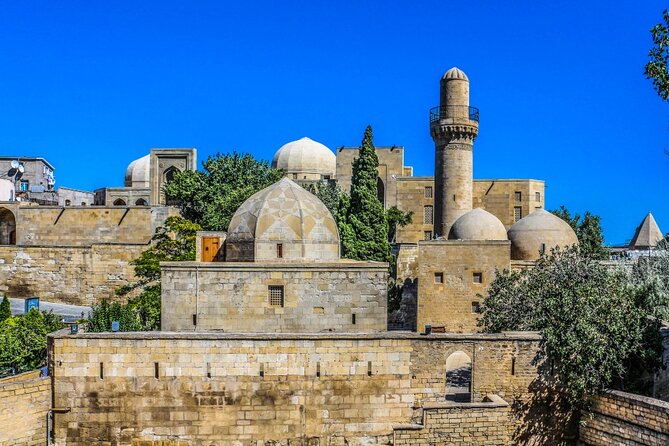
Baku’s Old City is at its best on foot, where a short turn off the main path can reveal a medieval bathhouse, a caravanserai courtyard, or an artist’s studio tucked into the fortress walls. This tour brings together the city’s headline sights, especially the Maiden Tower and Shirvanshah’s Palace, with smaller stops that many first-time visitors could easily miss.
I like the mix of major monuments and quieter corners, and I like that the group is limited to 15 people. At $25 per person, the tour is a reasonable way to get your bearings and hear the stories behind the stones. The main thing to consider is timing: the advertised 18 stops are a lot for an approximately two-hour walk, and admission to the two biggest attractions is not included.
In This Review
- Key points at a glance
- Why Baku’s Old City works so well on foot
- Gosha Gala Square and the Double Gates
- Caravanserais that tell Baku’s trading story
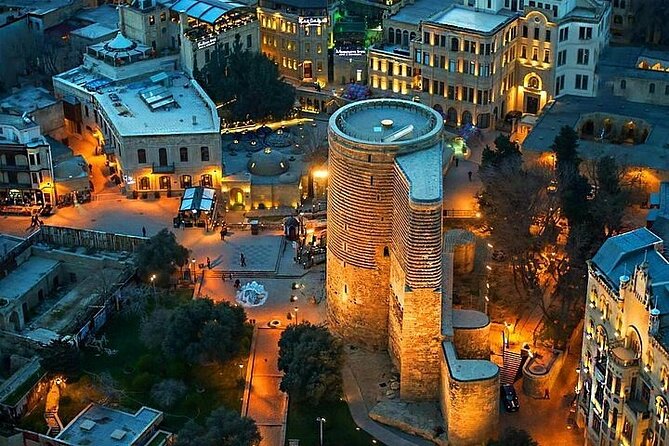
- The Maiden Tower, Baku’s most famous puzzle
- Bazar Square, St. Bartholomew, and an underground bath
- More caravanserais, mosques, and baths
- Aliagha Vahid and the miniature-book museum
- Shirvanshah’s Palace and the final fortress tower
- Is $25 a fair price?
- Who should book this walk?
- Should you book it?
- FAQ
- How long does the Baku Old City tour last?
- Where does the tour start and end?
- What is included in the price?
- Are admission tickets included?
- How many people can join the tour?
- Can I cancel for a refund?
Key points at a glance
- See Baku’s best-known landmarks: The route includes the Maiden Tower, Shirvanshah’s Palace, Gosha Gala, and the old fortress walls.
- Go beyond the headline sights: Caravanserais, medieval baths, a miniature-book museum, and an artist’s workshop add texture to the walk.
- Small-group format: The maximum group size is 15, allowing more room for questions than a large coach excursion.
- Plan for extra entrance fees: Tickets for the Maiden Tower and Shirvanshah’s Palace are not included in the $25 price.
- Start and finish in Icherisheher: Meet at Gosha Gala Square on Kichik Gala Street, and return to the same point.
- Allow for a brisk pace: The published stop timings add up to more than two hours, so some stops may be brief or viewed from outside.
Why Baku’s Old City works so well on foot
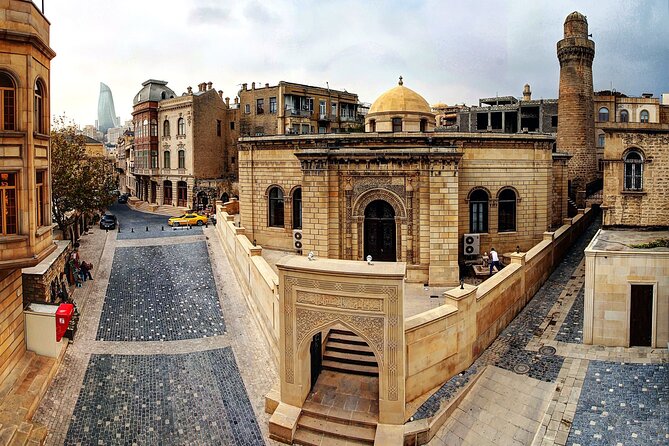
Icherisheher, also called the Inner City, is the walled historic core of Baku. Its narrow lanes, stone buildings, domes, arches, and fortress towers make it a compact place to explore, but the compact size can be misleading. Nearly every block carries several layers of history, from medieval trade to religious life and the later Russian period.
A guide helps you connect those pieces. Without one, the Maiden Tower may look like a striking stone cylinder, while a caravanserai may appear to be just another enclosed courtyard. With context, you begin to see how merchants, worshippers, bathers, rulers, artists, and residents all shaped the same small quarter.
The route is also useful early in a Baku visit. You finish where you started, so you can return later to the places that caught your eye. The Old City is easy to revisit, but a first walk with a local guide can save you from spending your limited time guessing which doorway or courtyard matters.
More baku old city tours in Baku:
- Baku Oil Heritage & Old Town Walking Tour
★ 5.0 · 232 reviews - Guba Khinalug & Candy Cane Mountains tour (by Old City Tours)
★ 4.5 · 208 reviews - Gabala + Shamakhi tour (by Old City Tours)
★ 4.5 · 198 reviews
Gosha Gala Square and the Double Gates
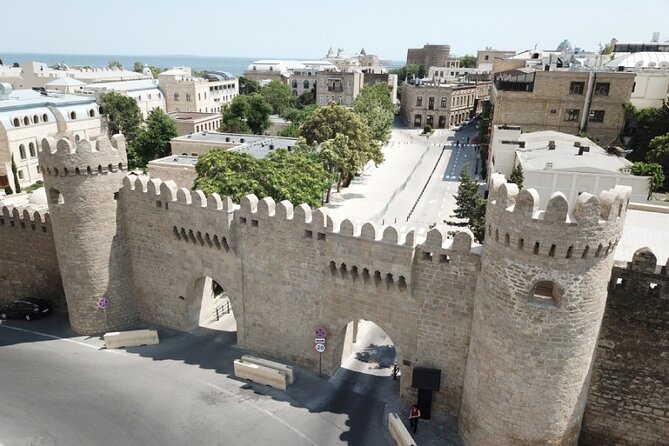
The meeting point is Gosha Gala Square, at 47 Kichik Qala. Gosha Gala means Double Gates in Azerbaijani, and these 12th-century entrances formed part of Baku’s defensive system.
This is a sensible place to begin because it introduces the Old City as a fortified settlement rather than simply a collection of old buildings. The gates have been preserved as part of the UNESCO-listed historic area, and your guide can explain how the walls controlled movement into the city.
The scheduled stop is only about two minutes, so expect a quick introduction and a look at the masonry rather than a long talk. Arrive ready to walk. Cobblestones and narrow streets are part of the character here, but they also call for comfortable shoes.
Caravanserais that tell Baku’s trading story
The next stops, the Bukhara and Multani caravanserais, show why Baku mattered along medieval commercial routes. These buildings offered merchants a secure place to rest, store goods, and meet other traders.
The Bukhara Caravanserai was built at the end of the 15th century. Its square courtyard, raised portal, perimeter balconies, and surrounding rooms create the classic caravanserai layout. The courtyard functioned as an open-air meeting place after the day’s business, and its shape remains one of the clearest ways to understand how these buildings worked.
Across from it, the Multani Caravanserai dates from the 14th century. It was associated with merchants from Multan, in present-day Punjab, who came to the region for trade. The building also connects with the story of Zoroastrian communities and the wider religious links between Azerbaijan and South Asia.
Both stops are listed as free and each is allotted about two minutes. That is enough to identify the buildings and hear their purpose, but not enough for a detailed architectural study. If caravanserais interest you, note their locations so you can return after the tour and look more closely.
The Maiden Tower, Baku’s most famous puzzle
The Maiden Tower receives about 10 minutes, making it one of the longer early stops. Dating to the 12th century, it is one of Azerbaijan’s best-known national symbols and appears on currency and official documents.
The tower’s purpose remains a matter of debate. It has been described as a defensive structure, an earlier religious site, and a possible example of pre-Islamic or Zoroastrian architecture. Those competing ideas are part of its appeal. A good guide should separate established facts from interpretation, especially at a monument surrounded by legends.
Entry is not included, so check the current admission cost before booking if you want to go inside. If you remain outside, you can still appreciate the tower’s unusual shape and location within the Old City, but an interior visit gives you more of a sense of its construction and place in Baku’s story.
The 10-minute allocation suggests that this tour is mainly an introduction. You will not have unlimited time for a slow visit, extended photography, or a long climb if the interior is open.
A few more Baku trips to weigh up
- Baku Guided Night Tour
★ 4.8 · 171 reviews - Baku: Gobustan/Absheron guided tour with lunch and tickets
★ 4.8 · 158 reviews - Baku: Guided Day Trip to Gabala with Hotel Pickup & Drop-off
★ 4.7 · 139 reviews - Baku : Gobustan, Absheron Sights Guided Day Trip Lunch included
★ 5.0 · 120 reviews
Bazar Square, St. Bartholomew, and an underground bath
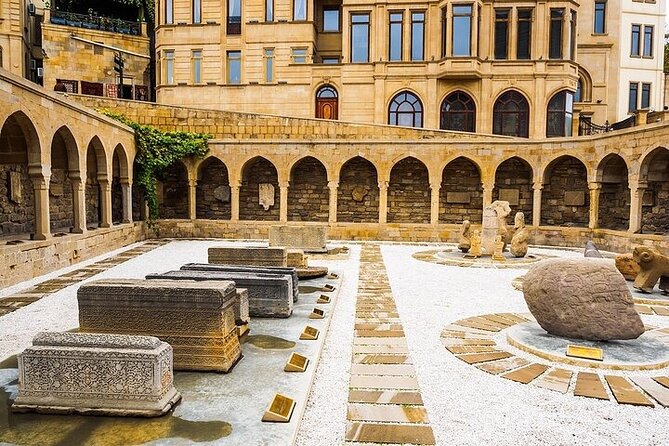
The walk then shifts from grand symbols to smaller sites. Bazar Square, also called the Khanqah complex, dates to the 12th or 13th centuries and includes an arcade connected with religious life. It was found during archaeological work near the Maiden Tower in 1964.
This is the kind of stop that benefits from explanation. Much of the structure is not as immediately obvious as the tower, and the site’s meaning depends on understanding how religious and commercial spaces overlapped in the medieval city.
Near the Maiden Tower, you also see the site of St. Bartholomew Church. The small Russian-style church was built in 1892 with donations from Baku’s Christian community, on a place traditionally linked with the apostle Bartholomew’s death in 71 AD. It operated until 1936 and was later demolished during the Soviet campaign against religion.
The church stop lasts about three minutes, so the emphasis is on the story and location rather than a substantial church visit. That brief stop is still worthwhile because it adds a Christian chapter to a route otherwise dominated by Islamic and pre-Islamic history.
The underground bathhouse is another unusual feature. Archaeologists uncovered it in 1964, and it dates to the end of the 15th century. It is associated with Haji Ghayib, the person who commissioned it, and Haji Bani, its architect.
You can expect to hear how a traditional bath worked and why bathhouses were central to Muslim cities. The remaining rooms, domes, and covering system show how architects created expressive interiors even in small spaces. With five minutes allotted, this should be one of the more useful short stops on the route.
More caravanserais, mosques, and baths
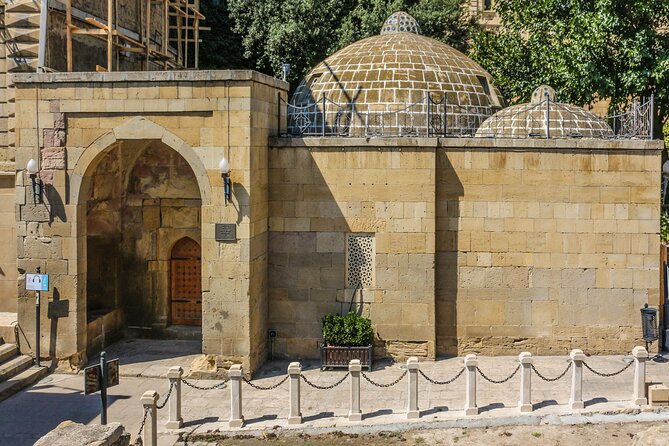
The two-storey Gasim Bey Caravanserai continues the trade theme. It is generally dated to the 15th century and is linked in some accounts to the reign of Shirvanshah I Khalilullah. Later, after Baku became part of the Russian Empire, it was associated with Gasim Bey and his heirs.
The Small Caravanserai is older, dating to the 12th century. Its square plan, inner courtyard, long balcony, and portal-shaped entrances show the practical design of a building that needed both hospitality and protection. The southern side once had two floors, while the medieval main entrance faced the sea.
These stops are scheduled for only a few minutes each. Think of them as a connected lesson about Baku’s trade network rather than separate museum visits. The guide’s explanation will likely be more important than the time spent examining each facade.
The Juma Mosque brings the route back to religious architecture. An inscription records restoration work in 1309, and a minaret was added in 1437. The mosque has been rebuilt several times, with the present structure dating to 1899 and funded by the Baku merchant and philanthropist Haji Shikhlali Dadashov.
The site may also preserve traces of a Zoroastrian temple, a reminder that Baku’s religious past did not begin with Islam. The five-minute stop should give you a useful overview, though it may not allow an extended interior visit.
The Gasim Bey Bath, also known as the Sweet Bath, dates to the 17th century. Bathers were served sweets with tea, which explains the nickname. Its plan included an entrance hall, changing room, bathing rooms, pools, and a boiler room, with ceramic tubes used to distribute heat and water.
The building was reconstructed in 1970 and later converted into a pharmacy known as the Green Pharmacy. The stop is only two minutes, so you will mainly hear the history and view the exterior or accessible parts.
Agha Mikayil Bath offers a different example. Built in the 18th century by Haji Agha Mikayil from Shamakhi, it has a larger interior than many other Old City baths and uses square dressing and bathing rooms under pointed arches and domes. It was restored in 2010 and remains a functioning bath.
That last detail gives the building a direct link to present-day Baku. The tour information does not promise bathing access, so treat it as a historic stop, not a spa visit.
Aliagha Vahid and the miniature-book museum
The Aliagha Vahid Monument honors an Azerbaijani poet and ghazal singer who lived from 1895 to 1965. The monument was designed and sculpted by Rahib Hasanov, with Sanan Salamzade as architect, and completed in 1990.
A stop here gives your guide a chance to explain a modern cultural figure rather than another medieval structure. That change of focus keeps the route from becoming a parade of dates and dynasties.
The Baku Museum of Miniature Books is one of the route’s most unusual stops. It opened in 2002 and contains more than 6,500 miniature books from 64 countries. The collection was assembled over 30 years by Zarifa Salahova, the sister of artist Tahir Salahov.
The museum received a Guinness Book of Records certificate in 2015 as the largest private museum of miniature books. Admission is listed as free, and the stop is allocated 10 minutes. That is enough to see the idea behind the collection and a selection of tiny volumes, but not enough to study the entire display.
This is a particularly good stop for families or anyone who likes small, unexpected museums. It also offers a pause from stone walls and religious monuments.
Shirvanshah’s Palace and the final fortress tower
The Palace of the Shirvanshahs is the tour’s other major monument. Built in the 15th century, it was connected with the Shirvanshah dynasty, which moved its capital from Shemakha to Baku after a devastating earthquake.
The palace complex includes the ruler’s residence and related architectural elements, and UNESCO describes it as one of Azerbaijan’s finest works of architecture. Along with the Maiden Tower, it forms the central historic monument group within Baku’s UNESCO-listed Old City.
Twenty minutes are allotted here, the longest stop on the route. That makes sense. The palace requires more time than a quick view from the street, and the guide can explain the dynasty, the move to Baku, and the way the complex reflects royal power.
Admission is not included. If you want to see the interiors, courtyard details, and full complex, budget for the ticket and be prepared for the tour to feel tight if every other stop receives its advertised time.
The Beyler Mosque is opposite the Murad Gate of the palace complex. It is recognized as a monument of national importance and gives you another look at the religious architecture of the Old City.
The route finishes at the Ali Shamsi Workshop and the Quadrangular Tower. Ali Shamsi’s studio displays the work of an Azerbaijani artist who studied at the Azerbaijan State Institute of Arts and later developed experience painting icons while living near a monastery outside Kharkiv.
The studio is listed as free to enter, with about 10 minutes available. It is more personal than a formal monument, and you may find the shift from royal architecture to a working artist’s space refreshing.
The Quadrangular Tower is the last remnant of a larger defensive system. Baku once had two substantial fortress walls, rebuilt many times after attacks. Following restoration in the 1950s, 25 semicircular towers and one quadrangular tower remained.
It is a fitting final stop because it returns you to the practical purpose of the Old City’s walls. From there, the activity ends back at Gosha Gala Square.
Is $25 a fair price?
At $25, you are paying for a professional guide and a structured walk through the Old City. The price does not include all fees and taxes, and admission to the Maiden Tower and Shirvanshah’s Palace is specifically excluded.
I consider the price fair if you want orientation, context, and a sensible route through sites that can be hard to identify on your own. It is less attractive if you plan to spend most of your time inside the two main monuments, since you will need to pay extra and may want more time than this tour allows.
The maximum group size is 15, which is small enough for questions without promising a private tour. The mobile ticket is convenient, and confirmation is provided at booking. The activity runs Monday through Sunday from 10 a.m. to 6 p.m. during the stated operating period.
You can cancel for a full refund up to 24 hours before the start time. Cancellations or changes made within 24 hours are not refunded or accepted, and the tour requires a minimum number of participants. If that minimum is not met, you are offered another date or experience, or a full refund.
Who should book this walk?
I would choose this tour if you are visiting Baku for the first time and want a clear introduction to Icherisheher without arranging a private guide. It suits families, couples, and small groups who prefer stories and local context to a long museum lecture.
It is also a good choice if you are interested in architecture. The route covers defensive walls, royal buildings, caravanserais, mosques, bathhouses, a church, and a working art studio in a small area.
You may want a different arrangement if you dislike brisk walking, need long photography stops, or want a detailed visit inside every monument. The schedule is ambitious. The listed stop times alone come to well over two hours, so the actual walk may involve shorter pauses, exterior explanations, or some flexibility from the guide.
Wear shoes suited to uneven streets, and consider returning later to the Maiden Tower or palace if either deserves more of your attention. The tour is best viewed as a well-planned introduction, not a full archaeological study.
Should you book it?
Book this Baku Old City tour if you want a moderately priced, small-group orientation that combines the famous sights with lesser-known baths, caravanserais, religious sites, and the miniature-book museum. Its strongest feature is the range of places covered in one walk.
Skip it if your priority is extended time inside the Maiden Tower and Shirvanshah’s Palace, or if you already know Icherisheher well. For most first visits, though, the route gives you a useful map of Baku’s oldest quarter and enough historical background to make a later independent walk more rewarding.
FAQ
How long does the Baku Old City tour last?
The tour lasts approximately two hours. The published route includes 18 stops, so the pace may be brisk and some visits may be brief.
Where does the tour start and end?
It starts at Gosha Gala Square, 47 Kichik Qala, Baku. The activity ends back at the same meeting point.
What is included in the price?
The $25 price includes a professional tour guide. All fees and taxes are not included.
Are admission tickets included?
No. Admission to the Maiden Tower and the Palace of the Shirvanshahs is not included. The itinerary lists several other stops as free admission.
How many people can join the tour?
The tour has a maximum group size of 15 participants.
Can I cancel for a refund?
Yes. You can cancel at least 24 hours before the experience start time for a full refund. Cancellations and changes made less than 24 hours before the start time are not accepted and are not refunded.
Just added around Baku
- Wine Tour Baku★ 5.0 · 4 reviews
- Traditional Azerbaijani Cuisine Workshop★ 5.0 · 5 reviews
- Tour to the North part of Azerbaijan Forests and Mountatin Quba★ 5.0 · 10 reviews
- Full Day KHINALUG and the Candy Mountains Tour★ 5.0 · 15 reviews
- Baku Sightseing Tour★ 5.0 · 12 reviews
- Small-Group Day Trip to Gobustan, Mud Volcanoes, Ateshgah & Yanar Dagh★ 4.5 · 3 reviews
- The Magnificent Baku Night Tour★ 5.0 · 3 reviews
- Sheki tour with overnight★ 5.0 · 5 reviews
Baku Old City Tours, compared.
Guba Khinalug & Candy Cane Mountains tour (by Old City Tours)
Read our review →
Baku Old City Tour (officially by Old City Tours)
Read our review →
Baku Old City Wonders: A Walking Tour Through Time
Read our review →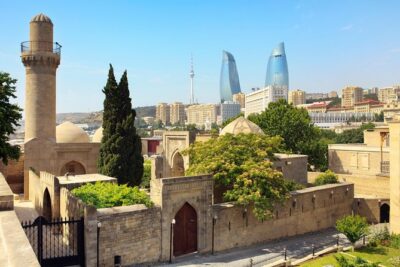
Browse the lists this tour appears in