
Reviewed · CITY TOURS
The Best Baku City Tour
Baku’s appeal is its sharp contrast: medieval lanes and mysterious towers sit beside oil-era mansions, grand government buildings, Flame Towers, and a long Caspian waterfront. This private city walk brings those layers together, with guides such as Abdullah, Mohammad, and Huseyn Ourbakli offering history, local context, and help finding your way on foot.
I like the Old City focus, where the Maiden Tower, Palace of the Shirvanshahs, Muhammad Mosque, and miniature book museum are close enough to form a clear first look at Baku. I also like the chance to talk about modern life, not just old stones, especially when the route reaches Fountains Square, the boulevard, and Highland Park.
The main caution is that the advertised route is ambitious for three to four hours. One guest found that several listed sights were not visited, so confirm the day’s plan with your guide if a particular building matters to you.
In This Review
- Key points to know before booking
- Baku in one walk: old walls, oil wealth, and Caspian views
- The Maiden Tower and Baku’s oldest mysteries
- Palace of Happiness and the city’s oil-rich past
- A school for girls and Azerbaijan’s short-lived parliament
- The miniature books that make a short stop worthwhile
- Muhammad Mosque and the story of the damaged minaret
- Walking the UNESCO-listed Inner City
- Fountains Square and the city outside the walls
- A church that reflects Baku’s difficult recent past
- Grand architecture from Baku’s oil boom
- Caspian Boulevard and Highland Park views
- How much value do you get for $22.10?
- Who will get the most from this Baku tour?
- Booking details that affect your day
- Should you book The Best Baku City Tour?
- FAQ
- How long does The Best Baku City Tour last?
- Where does the tour begin?
- Where does the tour end?
- Is this a private tour?
- What level of physical fitness is needed?
- Is admission included at every stop?
- Can I cancel for a full refund?
- What happens if the tour is canceled?
Key points to know before booking
- A private walking tour for your own group: You do not share the guide with a large sightseeing crowd.
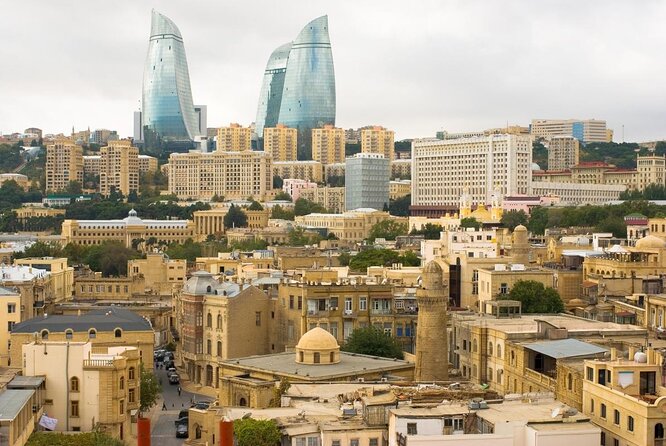
- A strong first visit to Baku: The route links the UNESCO-listed Old City with modern public spaces and Caspian views.
- Several unusual stops: The Museum of Miniature Books and Palace of Happiness add variety beyond the standard landmarks.
- A history-led experience: Guides connect buildings with oil wealth, parliament, religion, Soviet rule, and present-day Azerbaijan.
- Plan for moderate walking: The tour includes Old City streets, open public areas, and Highland Park, which can involve stairs.
- Good value at $22.10 per person: The price is modest for a private three to four-hour introduction, though admission details vary by stop.
Baku in one walk: old walls, oil wealth, and Caspian views
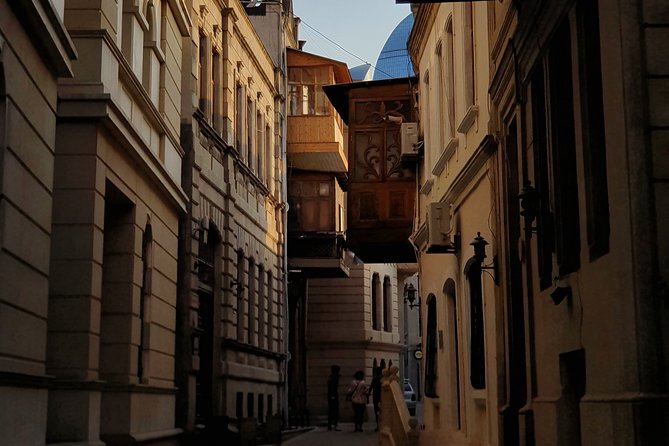
The tour begins at Icherisheher, Baku’s walled Inner City. This is the right place to start. You are immediately in the oldest part of the capital, where narrow streets, stone buildings, courtyards, mosques, and palace ruins give you a sense of Baku before its oil boom transformed the city.
The tour is listed at roughly three to four hours. That makes it a useful orientation walk rather than a slow, detailed museum tour. I would use it early in your stay, then return later to the Old City sites that deserve more time.
Because this is a private activity, the pace can be shaped around your group. That matters if you want to stop for photographs, ask questions about Azerbaijan’s politics and culture, or avoid rushing through every courtyard. It also means you should speak up if you want to linger at one place. The route contains more sights than most people can properly study in a few hours.
A few more Baku trips to weigh up
- Baku: Guba, Shahdag, Laza & Lunch w/ Free City & Night Tour
★ 4.8 · 1,455 reviews - From Baku: Gabala and Shamakhi Tour (Free Baku City Tour)
★ 4.8 · 695 reviews - Baku: Stunning Walking Tour of Historical and Modern City
★ 4.9 · 270 reviews
The Maiden Tower and Baku’s oldest mysteries
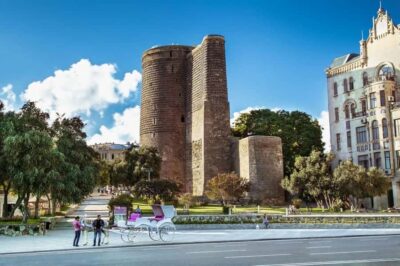
The Maiden Tower is the visual anchor of the Old City. It rises dark and sturdy near the southern edge of the walled quarter, looking toward the Caspian. No surviving written source clearly explains when it was built, why it was built, or how it received its name, which gives your guide a fine opening for discussing Baku’s legends and competing theories.
The planned stop is about 10 minutes, and the admission fee is not included. In practical terms, that is enough for an exterior introduction and photographs, but not a full visit inside if you want to explore the tower’s displays and upper views.
I like this stop because it shows how much of Baku’s character comes from uncertainty. You are not simply being handed one official answer. Ask your guide which explanations are accepted by historians and which belong more to local storytelling.
Palace of Happiness and the city’s oil-rich past
The Palace of Happiness brings you out of the medieval setting and into the world created by Baku’s oil wealth. It was built by millionaire Murtuza Mukhtarov as a surprise Valentine gift for his second wife, who admired a similar European building. He hired the Qasumov brothers to make a copy.
The story has a fairy-tale shape, but it also reveals how quickly Baku changed during the oil boom. Mukhtarov came from a modest background, taught himself technical skills, and became a major supplier of equipment to the oil industry. His success allowed him to commission grand architecture and move through circles that had once rejected him.
The exterior is the main attraction here. The visit is listed at 10 minutes, with admission included. That short pause works well in a city tour because the building gives you a quick lesson in ambition, wealth, romance, and the European influence visible across central Baku.
A school for girls and Azerbaijan’s short-lived parliament
The former Taghiyev School for Girls is now the Institute of Manuscripts of Azerbaijan. Its earlier name reflects a major change in education and public life. From 1901 to 1918, it operated as the Empress Alexandra Russian Muslim Boarding School for Girls.
The building then took on a political role. Taghiyev gave it to the parliament of the Azerbaijan Democratic Republic, which met there from December 1918 until April 1920. That republic lasted only 23 months before Bolshevik forces invaded, but the parliament was the first European-style parliament in the Muslim world.
You have about 15 minutes here, with admission included. The building is valuable less for a long interior visit than for the story it carries. It lets your guide explain that Azerbaijan’s modern identity is not only about oil, mosques, and Soviet rule. It also includes early attempts at a democratic state and expanded education for women.
Same city, a completely different kind of day:
- Baku: Gobustan, Mud Volcano, Fire Mount, Temple Lunch Entry
★ 4.9 · 3,246 reviews - BEST Gobustan, Volcanoes & Absheron Fire Tour (Group or Private)
★ 5.0 · 1,254 reviews - Gobustan and Absheron tour (All inclusive)
★ 5.0 · 1,014 reviews - Shamakhi And Gabala Tour (All inclusive)
★ 5.0 · 815 reviews
The miniature books that make a short stop worthwhile
The Museum of Miniature Books is one of the most unusual stops on the route. It opened in 2002 in the Inner City, and its collection was gathered over 30 years by Zarifa Salahova, sister of artist Tahir Salahov. The collection contains more than 6,500 books from 64 countries.
You are scheduled to spend about 20 minutes inside, and admission is included. That is not enough time to examine every case, but the museum’s compact scale makes it a good match for a short city tour. The collection includes books from Russia, the former Soviet republics, Europe, and Central Asia, along with rare editions connected to writers such as Pushkin, Gogol, Dostoyevsky, Chukovsky, and Barto.
I would not treat this as a major literary museum requiring half a day. Think of it as a memorable pause that breaks up the architectural sightseeing. The tiny books also remind you that Baku’s cultural attractions can be inventive and personal, not just grand.
Muhammad Mosque and the story of the damaged minaret
Muhammad Mosque, also called Siniggala Mosque, dates to the 11th century. Its second name refers to the damaged minaret. The damage came in 1723, when Russian warships approached Baku during the Russo-Persian War and began bombarding the city after its refusal to surrender.
A shell struck the minaret. Soon after, a storm pushed the ships back out to sea, and residents interpreted the event as divine punishment. It is a small but vivid story, and the 10-minute stop gives you a chance to see how military events, religious belief, and local memory overlap.
Admission is included. As with several stops, the time is brief. You will get more from this visit if you listen for the story rather than expecting a long architectural study.
Walking the UNESCO-listed Inner City
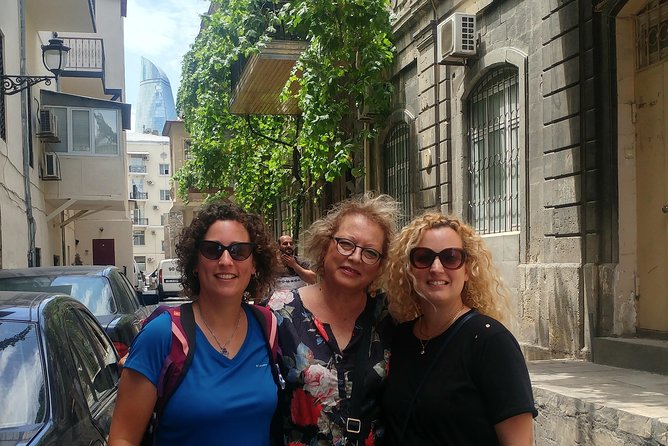
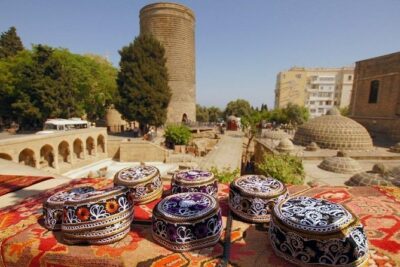
The main Old City segment lasts about 40 minutes. This is where the tour earns its price. Baku’s Inner City, including the Maiden Tower and Palace of the Shirvanshahs, became Azerbaijan’s first UNESCO World Heritage site in 2000.
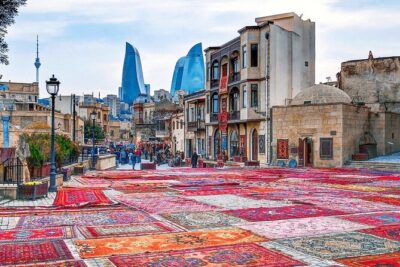
The walled quarter is compact, but it is not a single monument. You move through lanes shaped by centuries of trade, worship, royal life, and defense. The stone walls and uneven streets reward slow looking. Notice how the Old City feels enclosed, then compare it with the broad avenues and open squares outside the walls.
The Palace of the Shirvanshahs is listed for about 20 minutes, with admission free. Its complex includes courtyards, palace rooms, a crypt, cistern, baths, mosque, and other restored structures. Even a short walk through the courtyards gives you a better sense of daily life behind the walls.
If palace interiors are a priority, you may want to return independently. The time listed here is enough for orientation, not a full archaeological visit. Still, I consider this one of the most useful parts of the tour because the guide can show how the palace fits into the Old City instead of presenting it as an isolated building.
Fountains Square and the city outside the walls
Fountains Square shifts the mood. It is a central public meeting place lined with shops, restaurants, hotels, boutiques, and cafés. The fountains were first built during the Soviet period, and the square is still sometimes called Parapet, its former name.
The area is useful for seeing Baku as a living city rather than a collection of historic sites. Depending on the timing of your tour, you may find people strolling, shopping, or meeting friends. The route connects the square with Nizami Street and the walls of Icherisheher.
This is also a good point to ask your guide about everyday life in Baku. Several guides are praised for keeping the conversation open and personal, covering both the country’s past and current situation. Abdullah, in particular, is described as clear, friendly, and willing to discuss life in Baku beyond the monuments.
A church that reflects Baku’s difficult recent past
The former Armenian Church of St. Gregory the Illuminator is a more sensitive stop. Built in 1887, it survived Soviet anti-religious campaigns and was not demolished, unlike many houses of worship across the Soviet Union.
The church closed after the Armenian population left Azerbaijan during the Nagorno-Karabakh conflict in the late 1980s and early 1990s. It was damaged and is no longer open to the public. Admission is not included.
This is not a stop for a grand interior visit. It is a chance to confront a difficult part of the region’s modern history. Your guide’s handling matters here, and you should expect a serious explanation rather than a polished tourist story. The building’s condition and closed status are part of what you are seeing.
Grand architecture from Baku’s oil boom
The Baku City Executive Power building on Istiglaliyyat Street was built between 1900 and 1904 by Polish architect Iosif Goslavski, who served as Baku’s chief architect. Its baroque and classical design uses red brick brought from Italy, colored marble, and a central emblem featuring three golden torches.
The building is included for about 10 minutes. It is best appreciated from outside, with your guide explaining how foreign architects and imported materials shaped the city during its oil-fueled building boom.
The nearby Juma Mosque adds another layer. The mosque has functioned in the Inner City since the 12th century, though the present building was funded by philanthropist Khadja Shikhali Dadashev in 1899. It was built on a site associated with fire worship, and four old arches are said to remain from the earlier structure.
These stops work well together because they show Baku’s overlapping religious and architectural past. You see Islam, earlier fire-worship traditions, imperial influence, and the wealth of the oil era within a relatively small area.
Caspian Boulevard and Highland Park views
Baku Boulevard runs along the Caspian shore. Established in 1909, it grew beside the mansions of oil barons and now forms a long public parkway. The listed route includes two boulevard visits, one for about 15 minutes with admission included and another free 15-minute segment.
The boulevard gives you open space after the tight lanes of the Inner City. It is also a useful place to understand Baku’s relationship with the sea. The promenade stretches from National Flag Square toward Freedom Square, and plans have called for further expansion.
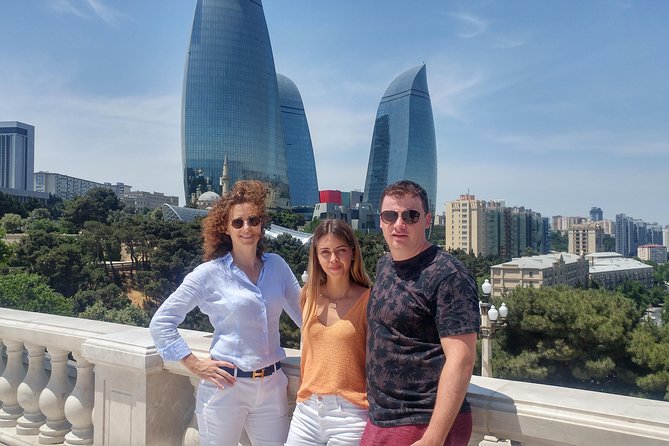
Highland Park is the highest point in Baku and offers broad views over the city and bay. You have about 30 minutes here, with admission free. The park can be reached by funicular from the boulevard in roughly seven to eight minutes or by climbing a long stone staircase. The route may approach it from the top, near the parliament, Martyrs’ Lane, and the Flame Towers.
This is one of the best photography stops. You can see the contrast between the old stone center, modern towers, waterfront development, and the Caspian beyond. If stairs are difficult for you, ask how this part will be handled before starting. The activity calls for moderate physical fitness, and the walking surface and elevation changes matter more here than at the city-center stops.
How much value do you get for $22.10?
At $22.10 per person, this is inexpensive for a private three to four-hour city introduction. The value is strongest if you are new to Baku and want a guide to explain why the city looks the way it does, rather than simply point out buildings.
The price is less compelling if you expect a full interior visit at every stop. Some places are exterior views or short pauses. Admission is not included at the Maiden Tower or Armenian Church, while several other stops are included or free. The Palace of Shirvanshahs is listed as free, and the miniature book museum includes admission.
You also need to measure the price against the route’s length. The schedule includes at least 12 named stops, plus Fountains Square, Juma Mosque, the Philharmonic Hall, and two boulevard segments. That is a lot for one afternoon. I would value a well-paced selection of the main sights more than a rushed attempt to tick every box.
Who will get the most from this Baku tour?
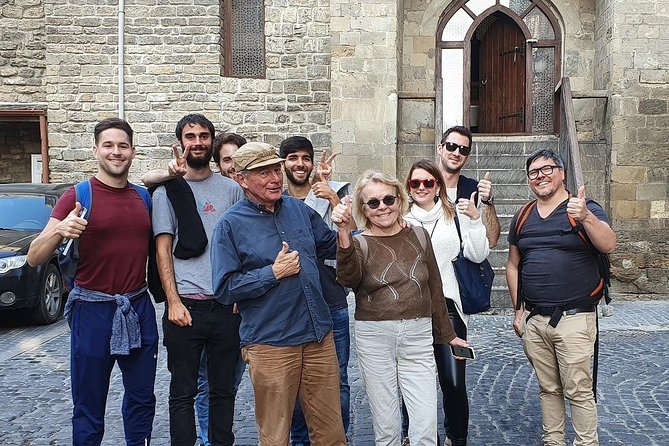
I would recommend it to first-time visitors, especially those with only a short stay. The mix of Old City landmarks, public squares, Caspian views, and modern Baku gives you a useful mental map for exploring on your own afterward.
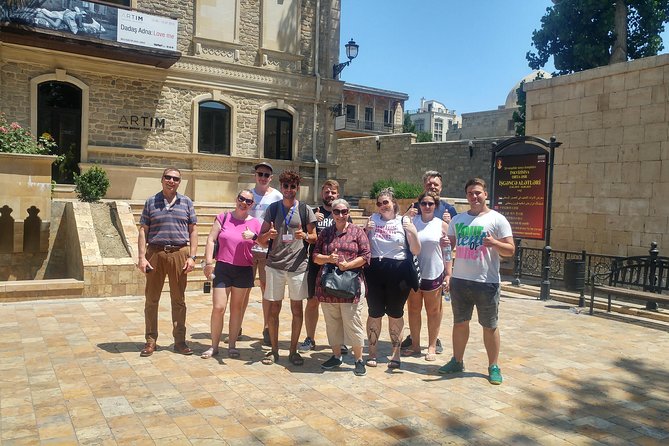
It also suits anyone who enjoys conversation. Guides have been praised for explaining history clearly without overwhelming people, and for discussing present-day Azerbaijan as well as the past. Abdullah, Mohammad, and Huseyn Ourbakli are among the guides associated with particularly positive experiences, though the guide assigned to you can vary.
Older visitors can enjoy it, but the moderate fitness requirement should be taken seriously. One couple over 70 had a very positive experience with a patient and friendly guide, yet the route still includes walking through the Old City and possible stairs at Highland Park.
I would be more cautious if you have one must-see site. Since the route is crowded with stops and one account describes several advertised locations being missed, message ahead and ask what will be covered. The provider has acknowledged that kind of mismatch and apologized for it, which is useful, but confirmation is still your best protection.
Booking details that affect your day
The meeting point is Icherisheher in Baku, and the tour returns there. A mobile ticket is provided, confirmation arrives at booking, and the activity runs near public transportation.
The experience is private, so only your group participates. Service animals are allowed. It requires good weather and a minimum number of participants, and cancellation is free up to 24 hours before the start time for a full refund. If bad weather or an unmet minimum cancels the tour, you are offered another date or a full refund.
Because guides often use WhatsApp to confirm arrangements, keep an eye on your messages before the tour. A guide once arrived a few minutes late after contacting the participant, while the message went unanswered. Clear communication about the meeting time and route can prevent a small problem from coloring the whole afternoon.
Should you book The Best Baku City Tour?
Book it if you want a low-cost, private introduction that combines Baku’s medieval core with oil-era architecture, public squares, Caspian waterfront, and Highland Park. The strongest parts are the Old City, the Maiden Tower story, the Palace of the Shirvanshahs, the miniature book museum, and the chance to ask a local guide about modern Azerbaijan.
Do not book it expecting a leisurely inspection of every museum and monument named in the schedule. The route is packed, and the exact selection may vary. For the best result, use this as your first look at Baku, tell the guide which two or three sights matter most, and return later to explore the interiors in detail.
FAQ
How long does The Best Baku City Tour last?
The tour lasts approximately three to four hours.
Where does the tour begin?
It begins at Icherisheher in Baku, Azerbaijan.
Where does the tour end?
The activity ends back at the Icherisheher meeting point.
Is this a private tour?
Yes. Only your group participates in the private activity.
What level of physical fitness is needed?
A moderate level of physical fitness is recommended. The tour includes walking through the Old City, public spaces, and Highland Park, where you may encounter stone stairs.
Is admission included at every stop?
No. Admission is not included at the Maiden Tower or the former Armenian Church. Several other stops include admission, while places such as the Palace of the Shirvanshahs and Highland Park are listed as free.
Can I cancel for a full refund?
Yes. You can cancel at least 24 hours before the local start time for a full refund. Cancellations or changes made less than 24 hours before the start time are not refunded or accepted.
What happens if the tour is canceled?
If poor weather causes cancellation, you are offered another date or a full refund. The same options apply if the minimum number of participants is not reached.
Just added around Baku
- Wine Tour Baku★ 5.0 · 4 reviews
- Traditional Azerbaijani Cuisine Workshop★ 5.0 · 5 reviews
- Tour to the North part of Azerbaijan Forests and Mountatin Quba★ 5.0 · 10 reviews
- Full Day KHINALUG and the Candy Mountains Tour★ 5.0 · 15 reviews
- Baku Sightseing Tour★ 5.0 · 12 reviews
- Small-Group Day Trip to Gobustan, Mud Volcanoes, Ateshgah & Yanar Dagh★ 4.5 · 3 reviews
- The Magnificent Baku Night Tour★ 5.0 · 3 reviews
- Sheki tour with overnight★ 5.0 · 5 reviews
City Tours, compared.
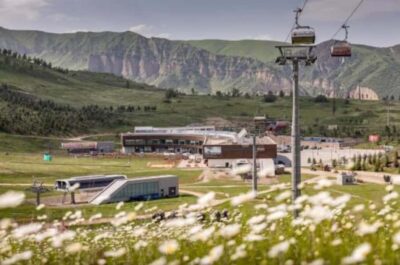
Guba, Shahdag, Laza & Lunch w/ Free City & Night Tour
Read our review →
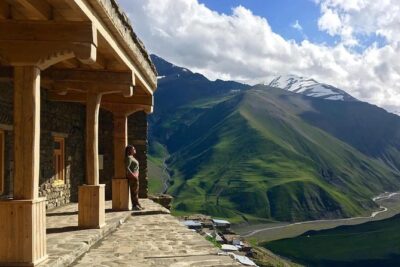
Guba Khinalug & Candy Cane Mountains tour (by Old City Tours)
Read our review →
Browse the lists this tour appears in